The VC's AI Prompt Library: 30 Prompts for Sourcing, Diligence, the IC, and Your Own Raise
A working library of AI prompts for VCs: sourcing, screening, diligence, IC memos, portfolio support, LP comms, and your own raise. Copy, paste, adapt.

Most VCs use ChatGPT or Claude the same way they'd use Google: one-line questions, generic answers, back to square one. The gap between that and getting genuinely useful output isn't the tool. It's the prompt.
Below is a working prompt library organized around the actual jobs a VC does across a week, from first contact with a founder to raising their own fund. Copy these directly, swap in your context, and adjust the tone to match your firm's voice.
Sourcing and Dealflow
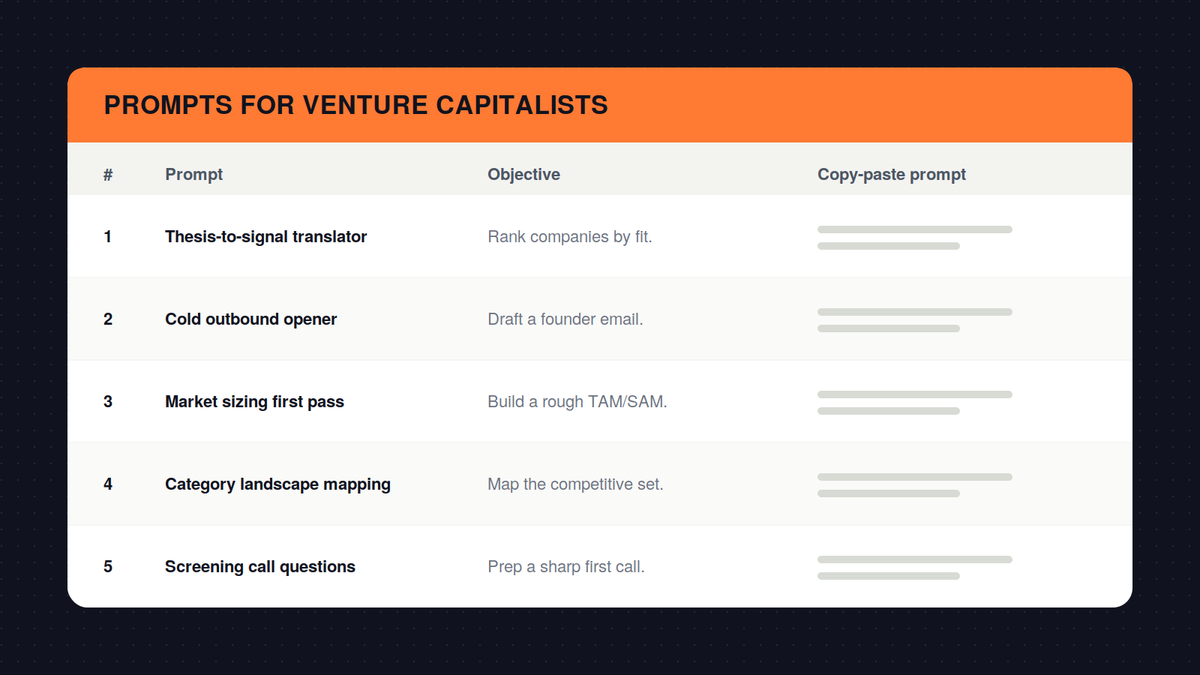
1. Thesis-to-signal translator "I invest in [stage] [sector] companies with a thesis around [specific thesis]. Given this list of companies [paste names/descriptions], rank them by fit and explain the reasoning for your top 5 picks in two sentences each."
2. Cold outbound opener "Write a first-touch email to a founder building [product category]. I found them through [source]. Reference something specific about their product, not their funding history. Keep it under 80 words, no compliments-only openers, end with a low-commitment ask."
3. Pattern recognition across a sourcing list "Here's a list of 20 companies I'm tracking [paste]. Group them into clusters based on underlying technical approach or business model, not just sector labels. Flag any that look like the same idea from different teams."
4. Market sizing first pass "Build a rough TAM/SAM/SOM estimate for [product category] targeting [customer segment]. Show your reasoning and the assumptions behind each number, not just the final figures. Flag which numbers are most uncertain."
5. Category landscape mapping "Map the competitive landscape for [category]. Group companies by go-to-market approach and by target customer size, not just by feature set. Note which companies have raised recently and at what stage."
Screening and Triage
6. Screening call question generator "I have a 20-minute intro call with a founder building [one-line description]. Generate 8 questions that would surface whether this is a top-decile opportunity in the first meeting, not generic ones like 'why now.'"
7. Pass or advance checklist "Based on these notes from a first call [paste], help me decide: pass, advance to a second call, or advance to diligence. Walk through what's strong, what's missing, and what a second call needs to resolve before I'd commit more time."
8. Deck first-read summary "Summarize this pitch deck [paste/describe] in the structure I actually care about: what they claim, what's evidenced versus asserted, and the single biggest unanswered question. Skip restating slides I can already read myself."
9. Polite pass email "Write a pass email to a founder after a first call. I want it to be genuinely useful, not a form rejection. Reference one specific thing about their pitch and be honest that fit was the issue, not quality."
Diligence
10. Reference call question set "I'm doing a reference call for a founder in [sector] at [stage]. The reference is a former colleague. Write 10 questions that go beyond 'would you work with them again' and get at how they handle pressure, disagreement, and ambiguity."
11. Cap table red flag scan "Review this cap table structure [paste, redacted] and flag anything unusual for a company at [stage]: excessive dilution, uneven founder splits, advisor equity that looks out of range, or option pool sizing that doesn't match stage norms."
12. Technical diligence question generator "I'm evaluating a company building [technical product description]. I'm not deeply technical in this area. Generate a list of questions I can ask their CTO that will reveal whether the technical approach is sound, without requiring me to already know the answer."
13. Customer reference call synthesis "Here are notes from three customer reference calls [paste]. Synthesize the common themes, flag any contradictions between what customers said and what the founder claimed, and note anything that needs follow-up."
14. Financial model sanity check "Review these SaaS metrics and projections [paste]. Flag any assumptions that look aggressive relative to typical benchmarks for a company at [stage] in [sector], and explain what would have to be true for the projection to hold."
The Memo and the IC
15. Bull case / bear case builder "Based on everything I know about [company] [paste summary], write the strongest honest bull case for investing and the strongest honest bear case against it. I want real tension, not a bull case with a token risk paragraph."
16. IC memo tightening "Here's my draft IC memo [paste]. Tighten it so the recommendation and the one or two reasons it could go wrong are unmistakable in the first paragraph. Cut anything that's context rather than argument."
17. Anticipating partner pushback "Here's my investment thesis for [company] [paste]. Play the role of a skeptical partner on my IC and raise the three hardest questions they'd ask. Don't soften them."
18. Pre-mortem prompt "Assume we invested in [company] and it failed 18 months from now. Write the most likely explanation for why, based on what we know today. Use this to identify what we should be watching for post-investment."
Portfolio Support
19. Portfolio founder check-in prompt "Draft a check-in message to a portfolio founder I haven't spoken to in 6 weeks. I want to open the door for them to share bad news without it feeling like a compliance check. Keep it under 100 words."
20. Board meeting prep summary "Summarize this founder's pre-read materials [paste] into the 3 things I should push on in the board meeting, and 2 things worth explicitly praising. Base this only on what's in the materials."
21. Follow-on decision memo "Help me structure a follow-on investment memo for [company]. Sections: what's changed since the last round, what the new capital unlocks, key risks that weren't present last round, and reference points from comparable companies at this stage."
22. Difficult feedback to a founder "I need to tell a founder that their [pricing strategy / go-to-market / hiring plan] isn't working. Help me draft this so it's direct and specific, not softened into vague encouragement, but still constructive."
LPs and Your Own Raise
23. Quarterly LP update first draft "Turn these bullet-point notes on portfolio performance [paste] into a quarterly LP update section. Tone should be direct and specific, not promotional. Lead with what changed since last quarter, not a general summary."
24. Difficult LP conversation prep "I need to tell an LP that [portfolio company] is likely writing down to zero. Help me draft talking points that are honest about what happened without sounding defensive or over-explaining."
25. Fund thesis one-pager "Help me sharpen this fund thesis draft [paste] into something a first-time LP could understand in two minutes. Cut jargon, keep the specific conviction, and make clear what we won't invest in as much as what we will."
26. Track record narrative "Given this list of portfolio outcomes [paste: company, stage invested, outcome], help me write a track record summary for a fundraise deck that's honest about the full picture, including the losses, not just the wins."
27. Anticipating LP due diligence questions "Play the role of an LP doing diligence on our fund before committing. Based on this draft deck [paste/describe], what are the five hardest questions you'd ask about our strategy, team, or track record?"
Platform, Brand, and Inbound
28. Content topic generator from your own dealflow "Based on these themes I've noticed across recent pitches [paste patterns], suggest 5 content angles I could write about that would be genuinely useful to founders in [sector], not generic thought leadership."
29. LinkedIn post from a real observation "Turn this specific observation from my week [paste: a pattern you noticed, a call you had, a trend in your dealflow] into a LinkedIn post. Keep my actual voice, don't inflate it into a listicle or add fake enthusiasm."
30. Podcast or event pitch angle "I want to pitch myself as a guest on [podcast/event type] about [topic I have real experience in]. Help me write a short pitch that leads with a specific, non-obvious point of view, not just my title and fund name."
What Still Needs You
A prompt library speeds up the mechanical parts of the job. It's worth being honest about what it can't replace, especially for an audience that's rightly skeptical of AI overreach in a people business.
- It won't judge character. Whether a founder is genuinely resilient under pressure or just good at sounding resilient is read in a room, not in a transcript.
- It won't replace conviction. A model can build you a bull case and a bear case. Deciding which one you actually believe, and being willing to be wrong, is still yours.
- It won't catch what wasn't said. Diligence prompts work on what you feed them. A founder's evasiveness on a question they never got asked won't show up in any summary.
- It won't build the relationship. LPs and founders can tell the difference between a message that was thought through and one that was generated and sent. Use these as a starting point, not the final draft, especially anywhere trust is on the line.
Getting More Out of These
- Give it your actual data. Paste real notes, real cap tables, real founder bios. Generic prompts on generic context produce generic output.
- Specify what NOT to do. "Don't write a compliment-only open" or "don't use general outlook language" does more work than any positive instruction.
- Ask it to flag uncertainty. Diligence and research prompts are far more useful when the model separates what it found from what it inferred.
- Treat every output as a first draft. These prompts get you to a strong starting point fast. The judgment call at the end is still yours.
Prompts Get You Started. Fundingstack Gets You Closed.
Every prompt above still leaves you doing the actual legwork yourself: finding the right LPs, getting warm intros, and keeping a fundraise organized as it moves. That's exactly what Fundingstack handles. If you're raising now or gearing up to, take it for a trial and see how much of that legwork it takes off your plate.